Rain World Subterranean Map: Filtration System, Gates & The Depths
A practical Rain World Subterranean map guide for Filtration System routes, shelters, karma gates, The Depths access, and safer late-game decisions.

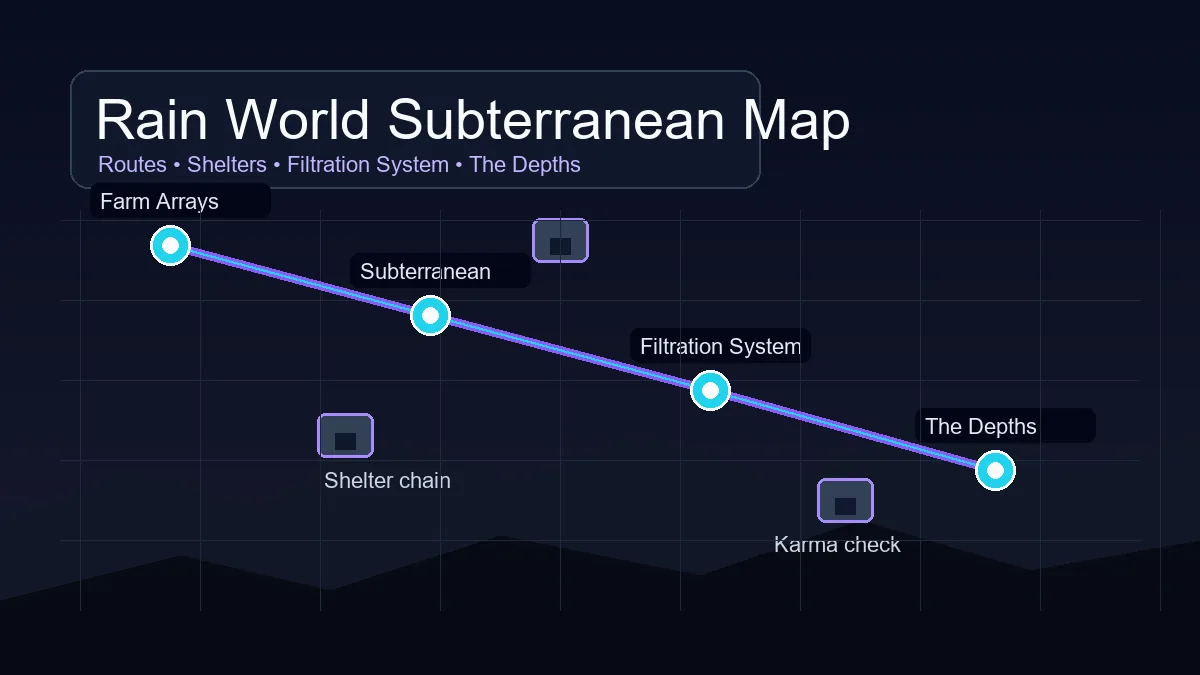
Table of Contents
The Rain World Subterranean map is a late-game route tool: use it to match the Filtration System, confirm shelter chains, check karma gates, and plan the approach to The Depths. This guide focuses on the region decisions a player can make now, while the interactive map remains the place for exact rooms and connections.
Quick Answer: How to Use the Rain World Subterranean Map
Start by confirming that you are in Subterranean or Filtration System, then mark the next shelter, the gate or exit you need, and one fallback. Treat The Depths as an objective with a route and survival check, not just a destination on the map.
Subterranean map routine
Confirm region -> find shelter -> check gate/exit -> plan Filtration System crossing -> mark The Depths approach
If you only need exact room positions, open the interactive Rain World map. If you are deciding whether to enter early, which exit matters, or how to survive the route, use the guidance below.
Subterranean Map Route Checks: Filtration System to The Depths
The strongest Subterranean map questions are route questions: where to save, which connection to test, whether Filtration System is the correct direction, and how to approach The Depths without wasting a cycle.
- Use shelter markers before committing to a long Filtration System crossing.
- Check gate and connection markers to separate a real exit from a dead-end detour.
- Treat The Depths access as a late-game route goal and verify the return plan.
Open the Rain World interactive map for exact rooms and use the Rain World progression guide for route fundamentals.
How to Read the Rain World Subterranean Map
Start by identifying your entrance. Subterranean is not a single straight tunnel; it is a set of underground paths that can connect back toward Farm Arrays, Drainage System, Shoreline-side routes, and the final descent. The same region can feel manageable or brutal depending on where you came from.
On the interactive Rain World map, enable shelters, gates, and region exits first. Only after that should you zoom into individual rooms. Your first objective is a shelter chain, not full exploration.
Find shelter spacing first
Subterranean cycles feel shorter because rooms are dangerous and route choices are costly. Identify at least two reachable shelters before committing to a long push.
Separate exploration from descent
Exploring side paths and reaching The Depths are different goals. Decide which one you are doing before entering Filtration System.
Check karma before the final route
A correct room path still fails if your karma state is wrong. Plan recovery cycles or echo visits before forcing the final gate.
Expect low visibility and high pressure
Subterranean is less about pretty landmarks and more about reading pipes, vertical drops, creature pressure, and safe return points.
Subterranean Route Table
Use this table to decide whether the branch you are looking at matches your current goal.
| Route or Entry | Best Use | Main Risk | Practical Notes |
|---|---|---|---|
| Farm Arrays entrance | Common late-game route after the standard progression path | Long travel and confusing shelter timing | Good when you are already descending after Five Pebbles and want a deliberate path toward the ending. |
| Drainage System side | Alternate access for experienced routing | Can feel hostile if you enter without food and shelter knowledge | Do not use this as a blind first route unless you enjoy difficult scouting. |
| Filtration System path | Route toward The Depths | High pressure, low margin for wrong turns | Treat it as a committed descent. Check karma and shelter status before pushing onward. |
| Side exploration branches | Learning the region, finding alternate exits, or returning later | Easy to waste cycles without reaching a meaningful exit | Explore only after you know how to return to a shelter. |
After choosing the route type, inspect room details on the interactive Rain World map
Subterranean Survival Plan
Subterranean becomes much easier when you treat each cycle as a small logistics problem.
- Enter with a clear objective: Know whether you are scouting, crossing, or descending to The Depths. Random exploration is the fastest way to lose karma.
- Mark your entrance mentally: If a route gets worse for two rooms in a row, knowing the way back is more valuable than pushing deeper.
- Prioritize shelter discovery: A new shelter is progress. Once you find one, use the next cycle to inspect the next branch instead of trying to finish the whole region at once.
- Use food as a route signal: If you cannot feed reliably, you may be on a route that expects better map knowledge or a different campaign state.
- Stop before the final descent if karma is wrong: The path toward The Depths is not only about room navigation. If karma blocks you, recover before throwing more cycles at the same gate.
Important Connections and Exits
Subterranean is important because it links late-game route choices to the final objective. These connections are the ones most players should understand before committing.
| Connection | When to Use It | Warning |
|---|---|---|
| Farm Arrays | Use it after standard progression when you are ready to descend. | The approach can be slow. Start a cycle with a shelter target rather than trying to cross by instinct. |
| Drainage System | Use it for alternate routing or experienced exploration. | It can become a difficult detour if you do not know where food and shelters are. |
| Filtration System | Use it when your goal is The Depths and the ending route. | This is not a casual side path. Prepare for a committed late-game push. |
| The Depths | Use it only when you have the correct late-game direction and karma state. | If you arrive too early, the map will not solve the progression requirement for you. |
Common Subterranean Mistakes
- Entering too early: Subterranean can be found before you are ready. Access does not mean it is the right next region.
- Using the map only after getting lost: Check entrances, shelters, and exits before the cycle starts. Reactive map use is much less helpful underground.
- Ignoring karma: A player can know the correct room path and still be blocked if the campaign state is wrong.
- Treating Filtration System as optional wandering: Filtration System is a late-game route segment. Enter it with a destination, not curiosity alone.
Final Advice for Subterranean
The best way to use a Rain World Subterranean map is to reduce uncertainty before entering: identify the entrance, the next shelter, the exit you want, and the karma state required for the final descent.
Subterranean is memorable because it feels hostile, deep, and final. That is also why a little planning matters. Use the map to choose a shelter-to-shelter route, then let the region stay tense without becoming directionless.
FAQ: Rain World Subterranean Map
References & Further Reading
- Rain World Wiki region documentation for region names and map context - Regions reference
- Rain World Wiki karma gate documentation for progression requirements - Karma gate reference
- Rain World Map progression guide for when Subterranean fits into the broader route - Progression route guide
Last updated: August 13, 2026