Rain World Five Pebbles Map Guide: Routes, Exits & Safe Checks
A practical Five Pebbles route guide for reading entrances, General Systems Bus, Unfortunate Development risk, shelters, and exits without turning the iterator into a blind maze.


Table of Contents
The Rain World Five Pebbles map is where many route plans stop being simple region order and start becoming room-level navigation. Five Pebbles can be entered from different sides, crossed through multiple interior systems, and exited toward The Wall, Underhang, or later route goals. This guide keeps the focus on practical map decisions: where you came from, what corridor you are trying to cross, when Unfortunate Development is worth avoiding, and how to leave the iterator without wasting cycles.
Quick Answer: Best Five Pebbles Map Route
For most first clears, treat Five Pebbles as a controlled crossing rather than a full exploration project. Enter from The Exterior or Underhang side, confirm the nearest shelter, move through the safer interior path toward General Systems Bus, reach the main story interaction, then choose an exit that matches your next region goal. If you are not confident with zero-gravity movement, avoid turning Unfortunate Development into your first route through the region.
Practical first Five Pebbles route
The Exterior / Underhang -> nearest shelter -> safer interior systems -> General Systems Bus -> Five Pebbles interaction -> The Wall or Underhang exit -> next shelter
The map should answer three questions before every push: which side of Five Pebbles am I on, where is the next shelter after the interior crossing, and do I have a fallback if the route through rot-heavy or gravity-shift rooms becomes too expensive?
Keyword Boundary and Similarweb Decision
This page was selected because it has a distinct region-route intent that the homepage and broader progression pages only mention in passing. Similarweb keyword generator returned sparse exact data for the long-tail Five Pebbles seed, so the decision uses Similarweb site-keyword context, the three empty generator tabs as low-volume evidence, repository conflict checks, and SERP intent review.
| Candidate | Metric source | Intent fit | Action |
|---|---|---|---|
| rain world five pebbles map | Similarweb generator: phrase/related/questions all 0 records under KD 1-30; SERP shows map/wiki/video route intent | Distinct region-map intent; not owned by homepage broad map page | Create this new page |
| five pebbles map | Similarweb generator: no low-KD records; SERP confirms navigational region guide intent | Supports the primary topic | Use in headings, FAQ, and internal anchors |
| rain world five pebbles guide | SERP + repository check; existing progression page mentions it only as one route step | Guide intent needs crossing/exits/shelter detail | Use as secondary keyword |
| rain world interactive map | Similarweb site keywords: KwVolume 1650, Difficulty 57, clicks 90 to homepage | Broad tool intent already owned by homepage | Internal-link anchor only |
| rain world progression guide | GSC/Site context maps to existing progression page | Whole-game route order, not a Five Pebbles crossing guide | Do not target; link as support |
| rain world monk route | Repository conflict: progression guide already has Monk route section | Existing-page support intent | Add no new page |
| rain world outskirts map | Homepage/Survivor already answer start-region checks | Support section or FAQ only | No action in this page |
| rain world rivulet map | Downpour page already has Rivulet support row | Future slugcat page candidate, not Five Pebbles page | Keep as future-page flag |
How to Read Five Pebbles as a Route, Not a Maze
Five Pebbles looks overwhelming if you open a full map and try to understand every room at once. Read it as a chain of entry, shelter, crossing, story point, and exit decisions. That is enough for most players trying to progress from mid-game route planning into late-game direction.
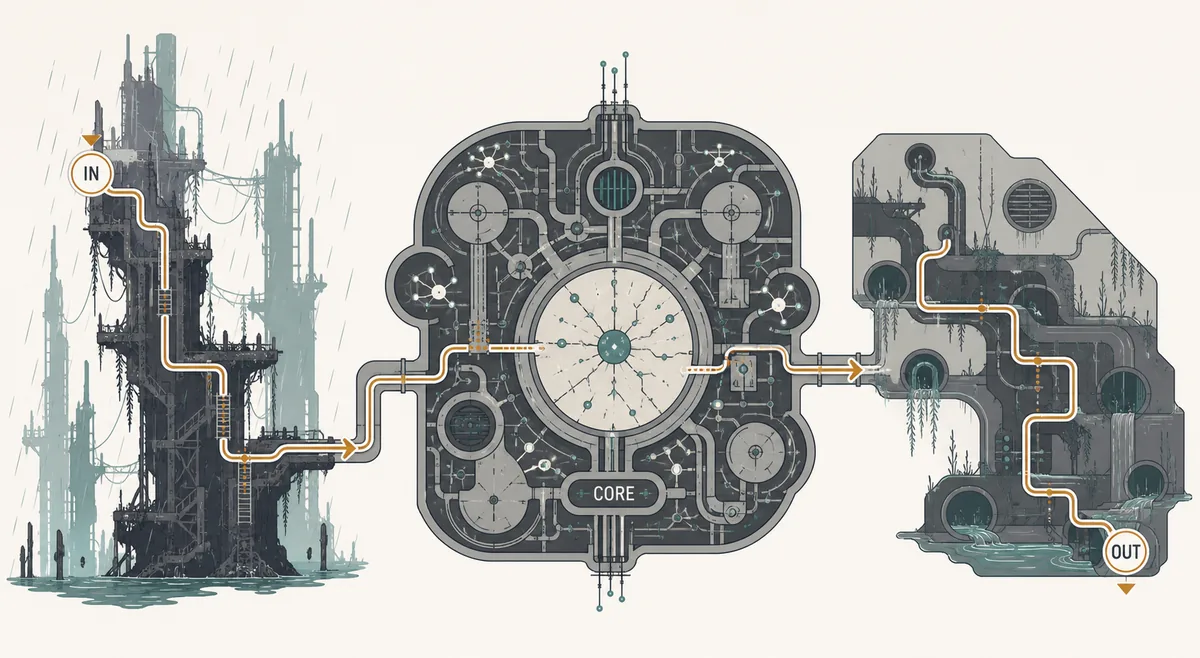
Do not judge the route by physical distance alone. A shorter-looking room chain can be worse if it requires awkward gravity movement, heavy rot pressure, or a long stretch without a safe shelter.
| Stage | Map check | Why it matters | Warning |
|---|---|---|---|
| Entry side | Identify whether you are coming from Underhang, The Wall, or another Exterior-side route. | The entrance decides which shelters and corridors are realistic. | Do not follow a guide written for a different side without checking the first shelter. |
| First shelter | Mark the closest shelter before pushing deeper into the iterator. | Five Pebbles punishes long blind cycles. | If the shelter is unclear, scout first and return. |
| Interior crossing | Choose the safer systems route before considering harder rot-heavy detours. | A stable crossing is more useful than a theoretically shorter route. | Unfortunate Development can waste cycles if you are still learning movement. |
| Story interaction | Know when the route goal is to reach Five Pebbles, not to loot every chamber. | This is the reason most first routes enter the region. | Overexploration after the story point can make the exit harder. |
| Exit choice | Pick The Wall, Underhang, or another onward direction based on your next campaign goal. | The best exit is the one with a known next shelter. | Leaving on the wrong side can force a long recovery route. |
| After-route check | Before moving on, confirm karma, food, and the next region objective. | Five Pebbles often changes your route priority. | Do not descend or backtrack until the next shelter chain is clear. |
For exact room layouts and gates, open the interactive Rain World map
Which Entrance or Exit Should You Use?
Most Five Pebbles confusion comes from mixing route advice for different entrances. Use these entry notes to match the map to your actual position.
Underhang-side approach
Use this when you are climbing from The Exterior and need a controlled interior crossing. Prioritize shelter spacing and movement stability before speed.
The Wall-side approach
This can be useful when you already understand vertical routing, but it is less forgiving if you are unsure where the next shelter or exit sits.
General Systems Bus path
This is the useful mental landmark for many first clears. Treat it as a route corridor, not as a reason to inspect every side room.
Unfortunate Development detour
Use it only when you understand the risk. It belongs in a guide as a warning and optional challenge, not as the default first route.
Shelter, Rot, and Gravity Planning
The hard part of Five Pebbles is not only knowing the map. It is surviving enough awkward movement to make the map useful. Plan each crossing around a shelter target, a fallback, and a decision about whether a dangerous detour is worth the time.
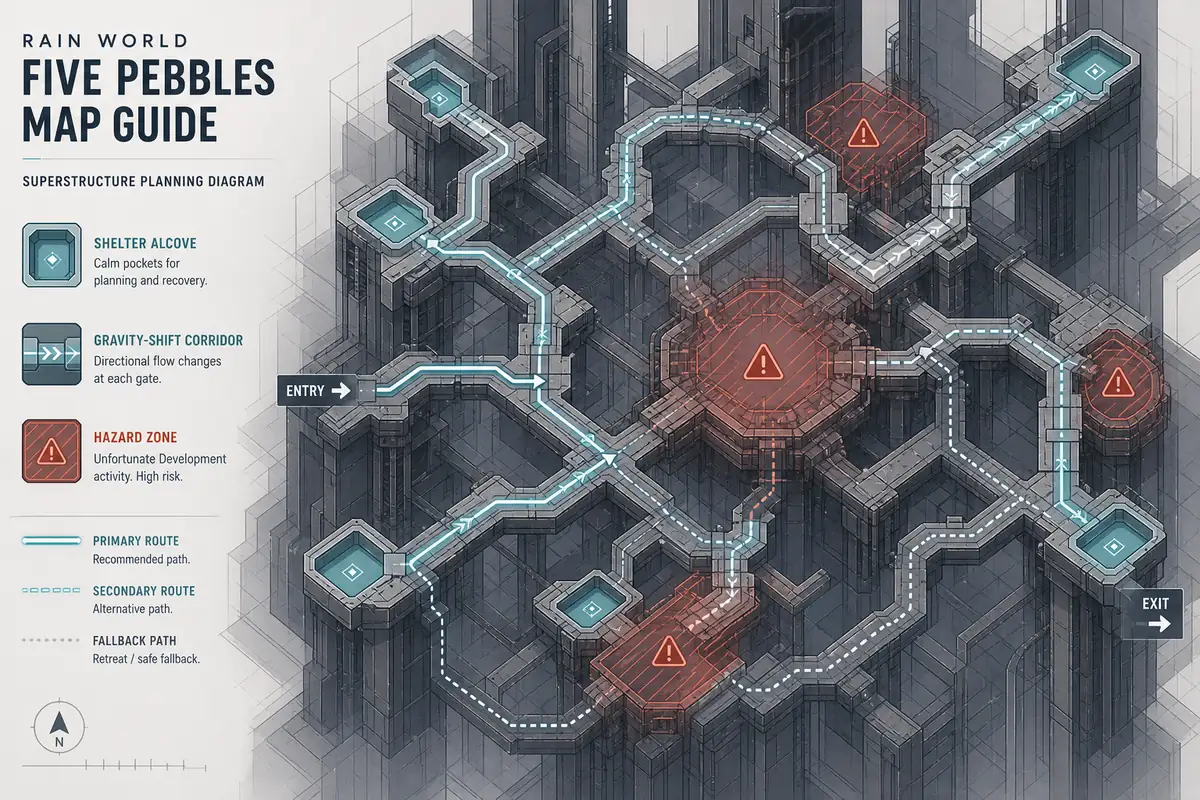
- Start with a shelter target: If you cannot name the next shelter, do not commit to a long crossing.
- Keep the route goal narrow: For a first clear, the goal is usually to reach the story interaction and leave, not to solve every side room.
- Treat rot-heavy rooms as optional risk: Unfortunate Development can be explored later; it does not need to be the first way you learn the iterator.
- Check the exit before the push: Know whether you plan to leave toward The Wall, Underhang, or a return path before you spend the cycle.
- Review deaths with the map: After a failed attempt, mark whether the mistake was shelter spacing, movement, wrong entrance, or overcommitting to a detour.
Campaign Differences Inside Five Pebbles
Five Pebbles does not mean exactly the same thing in every campaign. The map route should change depending on why your slugcat is entering the iterator.
| Campaign | Five Pebbles role | Route note |
|---|---|---|
| Survivor / Monk | Major mid-to-late route beat and direction change. | Use the safer crossing, get the story direction, then choose the exit that supports the late-game descent. |
| Hunter | High-pressure route point because cycle time matters. | Avoid unnecessary exploration and keep shelter chains short; use the Hunter guide for time-limited decisions. |
| Spearmaster | Story objective with pearl-related consequences. | Use the Spearmaster page for pearl delivery and return routing instead of treating this as a normal visit. |
| Rivulet | Fast movement changes route tolerance. | Prioritize quick transitions and exit clarity; the broader Downpour page owns the general DLC map decision. |
| Saint | Late-era map assumptions can change. | Do not copy Survivor route notes blindly; use Saint-specific route planning for late campaign states. |
Common Five Pebbles Map Mistakes
- Reading the whole iterator before choosing an entrance: Start from your current side. Five Pebbles advice is only useful when it matches the entrance you actually used.
- Assuming the shortest line is safest: Rot, gravity, and shelter spacing matter more than visual distance on the map.
- Using Unfortunate Development as the default path: It is a memorable area, but it is not the best first route for many players.
- Forgetting the exit plan: Reaching the story point is not the end of the route. You still need a clean way out and a next shelter.
- Competing with the homepage map intent: Use this page to decide how to cross Five Pebbles, then use the interactive map for exact room checks.
Final Advice for Five Pebbles Routing
The best Rain World Five Pebbles map plan is a narrow, shelter-aware route. Identify the side you entered from, choose a stable crossing, avoid unnecessary dangerous detours on a first visit, and leave through the side that supports your next campaign goal.
Use the interactive map for exact rooms only after this route decision is clear. That keeps Five Pebbles challenging without turning the region into a blind maze or a full spoiler scan.
FAQ: Rain World Five Pebbles Map
References and Further Reading
- Community region and lore reference for Five Pebbles - Rain World Wiki: Five Pebbles
- Region connection overview for Rain World routing - Rain World Regions
- Whole-game route order after the Five Pebbles visit - Rain World Progression Guide
- Late-game descent planning after leaving Five Pebbles - Subterranean Map Guide
Last updated: July 5, 2026