
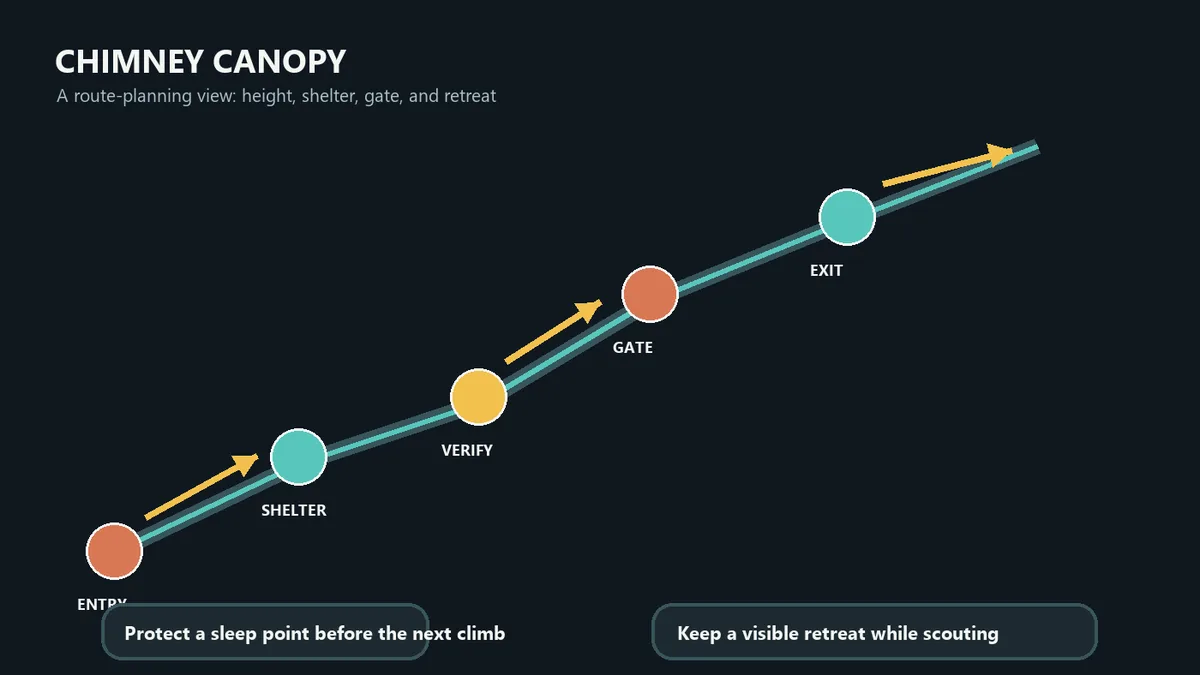
This Chimney Canopy map Rain World guide is a route-planning tool, not a picture to memorize. The region combines high platforms, vertical shafts, awkward landings, exposed crossings, and transitions that can cost a cycle. Start with a shelter rather than the highest marker: identify your entrance, locate the next sleep point, trace beyond each difficult jump, and keep a retreat visible. Slugcat, campaign, karma, food, and objective can change the sensible branch, so this spoiler-light guide explains the live map instead of promising one fixed room list.
What a Chimney Canopy map Rain World guide should answer
When players search for a Chimney Canopy map, they need the entrance, recovery point, worthwhile climb, gate implication, and campaign exit. Put those decisions in order so the map is readable before the player is lost.
Route shape
Separate climbs, exposed traverses, dead ends, and branches that need a deliberate return.
Recovery points
Find shelters first so a failed jump costs a decision, not the whole route.
Objective fit
Match gates, Echo checks, goals, and exits to the current run.
If you arrive from another high region, compare the shelter-first logic in the Sky Islands map guide before choosing a long climb.
Quick answer: the safest Chimney Canopy route logic
Start from your actual entrance, then find the nearest dependable shelter in the interactive map. Move upward in short sections. At each landing, check the next connection, escape space, and the route back to the shelter. Commit toward a gate, Echo, collectible, or exit only after those checks. Several uncertain jumps before the next shelter mean scouting, not a crossing you must finish now.
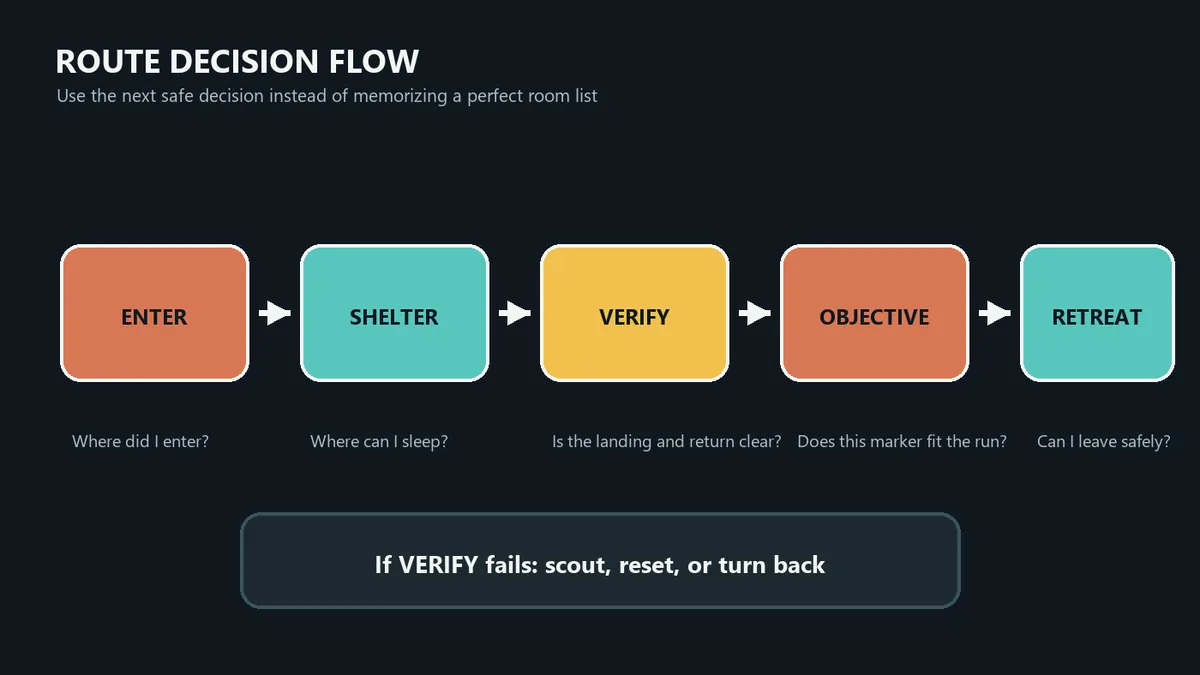
Route decision chain
Entry → shelter → landing check → gate or objective → exit → retreat
This chain is more durable than a room-by-room walkthrough. The sequence can vary with campaign access and entry direction, but stabilize, verify, and keep a turnaround until the route is confirmed.
How to read a Chimney Canopy map
Open the regional view before leaving your shelter. Begin with connections, shelters, karma gates, and the marker for your objective. Hide collectibles until the route is clear. Follow beyond the ledge you want, because a landing may still create a bad return or one-way drop.
Read the map upward and backward. Upward shows exposure and the next decision; backward shows whether a failed attempt leaves a way to safety. Compare shelters and gate requirements alongside distance. The shortest line is not always useful when a fall costs a cycle.
1. Mark the entrance
Confirm the transition you used, not the region's most familiar side.
2. Protect a shelter
Choose a sleep point and make the first goal fit one cycle.
3. Trace the landing
Inspect the next room, escape space, and return direction.
4. Filter the objective
Turn on only the gate, Echo, or exit layer needed now.
For exact rooms, open the Rain World interactive map after choosing the next decision.
Chimney Canopy entry-to-exit route plan
Use this as a checklist, not a promise that every campaign uses the same rooms. Replace each stage with a verified connection and stop when recovery is no longer true.
| Stage | Map check | Why it matters | Warning |
|---|---|---|---|
| Enter | Identify transition and nearest shelter | Know your retreat side | Read the approach first. |
| Stabilize | Reveal the next sleep point | Set a cycle goal | An exposed platform is not recovery. |
| Climb | Trace past the jump | See the next room and return | A landing can still create a bad retreat. |
| Gate | Check karma and another branch | Choose progress or a safe loop | A closed gate is information. |
| Objective | Open the Echo, item, or campaign layer | Confirm the marker fits | A marker does not prove conditions are ready. |
| Exit | Compare the exit with the next region | Carry a shelter-aware route | Turn around before losing the way back. |
Match the regional plan to your entrance and slugcat, then check the map's shelter and connection layers.
Shelters, falls, and vertical hazards
Chimney Canopy rewards patience because height can hide how little recovery space a route provides. Before a difficult climb, identify the shelter, a pause point, and where failure means leaving. This turns a vague push into a repeatable decision: the map records where the attempt should end, not only the next icon.
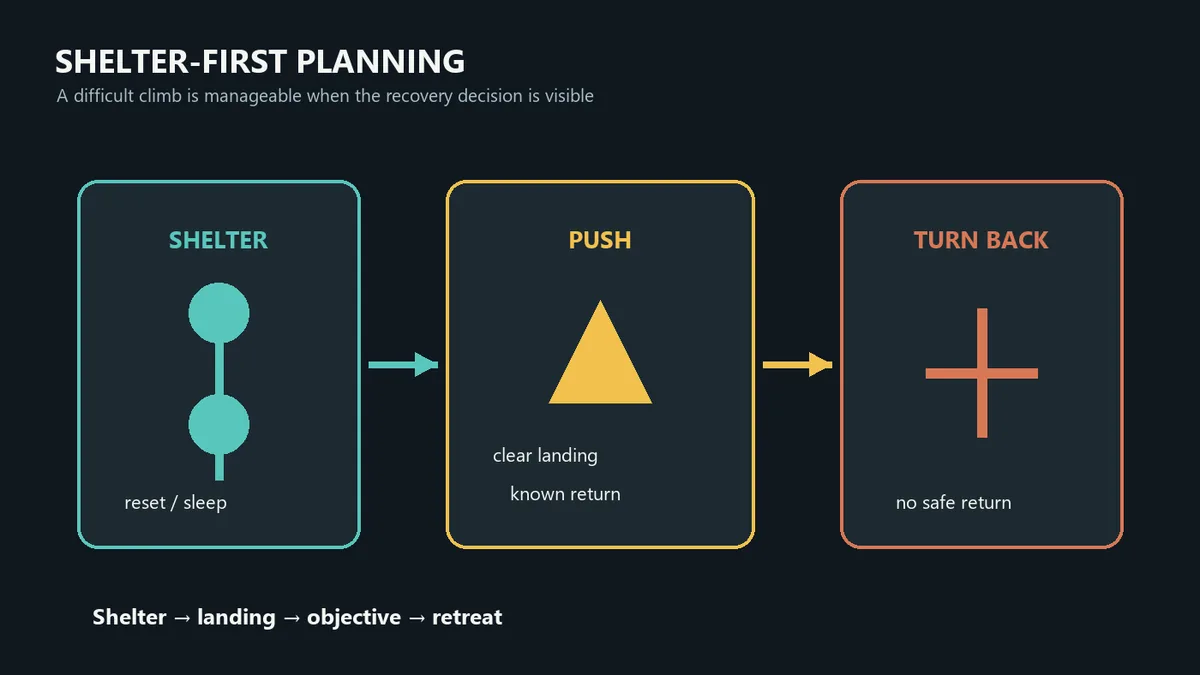
- Sleep before pushing: If several jumps are uncertain, use the closest known shelter instead of carrying an untested route.
- Read the second landing: Look beyond the next ledge. A landing without room for the next move or retreat may be worse than a longer connection.
- Change the attempt: After a failure, alter the angle, entry room, or objective. Repeating a blind jump adds no information.
- Respect open exposure: Long gaps and limited cover change timing. Keep a pause point visible before the open section.
- Turn around early: A retreat preserves the shelter and gives the next attempt a known start.
Record the next shelter, safe landing, gate status, and stop point. Those anchors reduce reliance on perfect movement.
Karma gates and campaign checks
A Chimney Canopy route can look correct on a map and still be wrong for the current campaign. Treat the karma gate as a checkpoint: confirm the requirement, compare another connection, and decide whether to build karma, use a safer loop, or pursue another objective. Branches differ by slugcat and campaign state.
- Check the current karma: Read the requirement before a long exposed approach. A nearby route is not automatically ready.
- Confirm the campaign: Slugcat abilities and campaign rules can change region and objective order.
- Keep an alternate line: If the gate blocks the plan, find a shelter loop or return route instead of repeating the barrier.
- Separate markers from conditions: An Echo, item, or exit icon identifies a location; it does not replace karma or story conditions.
Pair this view with the progression and Echo guides, then verify rooms and live conditions in the interactive map.
Campaign and slugcat notes
There is no universal Chimney Canopy route. Use the row that matches your run, then filter the map by objective and accessible connections.
| Campaign | Route focus | Map rule |
|---|---|---|
| Survivor / Monk | Learn the shelter baseline | Prefer a clear retreat. |
| Hunter | Protect limited cycles | Bring a shelter chain and backup objective. |
| Artificer | Manage combat and gate pressure | Choose room space before a high marker. |
| Gourmand | Balance food and distance | Use a safe reset when a detour grows. |
| Rivulet / Saint / exploration | Adapt to abilities | Filter usable branches instead of copying order. |
The region may be a passage, gate check, Echo visit, detour, or return route. Name the objective before enabling layers so each marker answers a question.
Common Chimney Canopy map mistakes and recoveries
Most failed crossings begin as planning errors rather than one bad movement. These recoveries keep the regional map useful.
- Chasing the highest marker: Return to the last shelter and inspect the next landing. Height is not automatically progress.
- Hiding the shelter layer: Turn shelters back on. Without a sleep point, a route is only a possibility.
- Treating one route as universal: Filter by campaign, slugcat, karma, and objective before copying a connection.
- Repeating a blind jump: Scout from the other side, change the approach, or postpone it after the first failure.
- Ignoring the way back: Trace a retreat first. If it is unclear, make the current shelter the objective.
Use the map for decisions, not memorization
A strong Chimney Canopy map Rain World guide does not promise one perfect route. It gives you a repeatable order: confirm the entrance, protect a shelter, verify each landing, check the karma gate and objective, then leave while a retreat exists. The order still works when a predator changes timing or a jump fails.
For exact rooms, open the interactive map and turn on only the needed layers. Pair this guide with Sky Islands for the approach, Farm Arrays for the open-ground connection, the progression guide for the wider route, and the Echo guide for a visit objective.
Chimney Canopy map FAQ
References and map tools
- Interactive map for room connections - Open the interactive map source
- Community Chimney Canopy reference - Read the Chimney Canopy reference
- Official Rain World page - Visit the official Rain World page
Last updated: September 14, 2026