
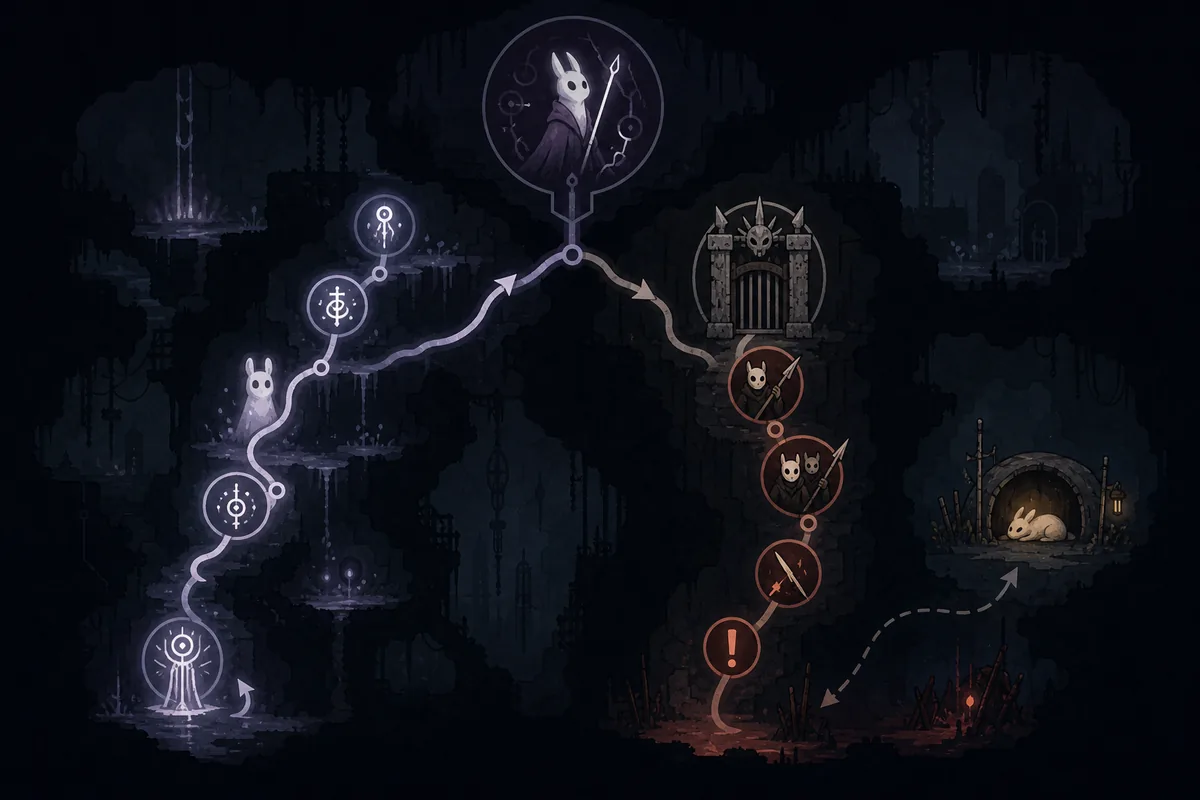
Rain World karma gates separate regions and turn a simple map connection into a preparation check. You need enough current karma to meet the symbols shown inside the gate, but a successful activation is only the beginning of the decision. The next region may have a long shelter gap, a different food loop, a one-way exit, or a campaign-specific rule. This guide explains the general mechanic, a practical recovery loop, and the exceptions that make a gate look broken when it is actually working as designed.
Quick answer: what Rain World karma gates do
A karma gate is a region transition that checks your current karma against the requirement displayed in its chambers. If your level is high enough, enter the chamber, stop moving for the activation sequence, and wait for the gate to finish. The transition loads the next region; it does not permanently raise your karma or guarantee a safe first shelter on the other side.
If the requirement is higher than your current level, return to a known shelter, survive a cycle, visit an Echo when the campaign allows it, or choose another connection. Read every gate as a short checklist: requirement, food, shelter, route back, and campaign layer.
- Check the symbol before leaving the shelter, not after crossing the whole region.
- Keep one recovery route visible; a gate can be passable and still be a poor next objective.
- Use the matching slugcat or campaign layer in the interactive map.
- Treat editorial diagrams as planning aids and the interactive map as the source for exact rooms.
How a Rain World karma gate works
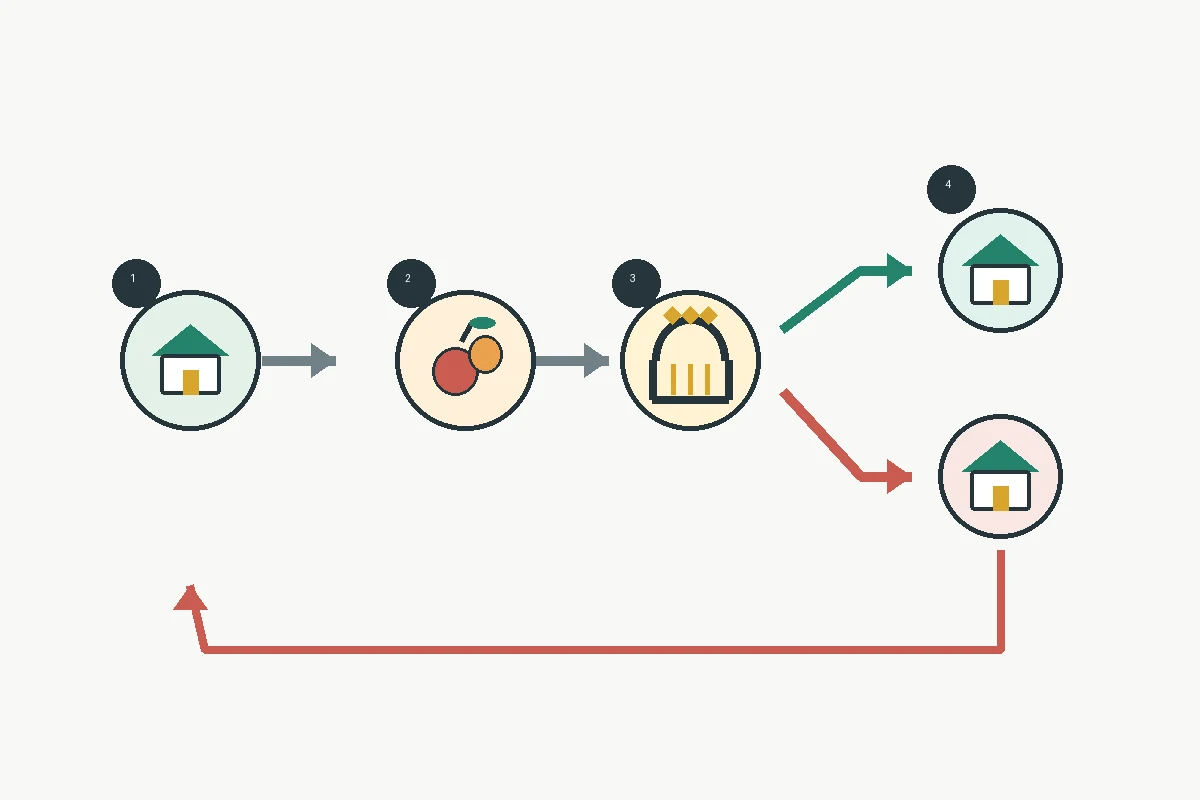
The gate contains two chambers and a mechanical sequence that evaluates the slugcat's current karma. Stand in the chamber on the side you are leaving, remain still, and let the shutters, water, heat, or electrical indicators complete their cycle. Moving away too early can interrupt the attempt, while entering with an insufficient level simply produces the red warning response rather than a transition.
A gate can also be unavailable because it was already used during the current cycle. That is different from failing the karma check. When a used gate refuses to activate, plan around the next shelter and cycle instead of trying to force it.
- Read the symbols: Compare the requirement in the chamber with the karma level shown in your HUD.
- Prepare the approach: Carry enough food to reach a shelter and keep a known route back if the next region is hostile.
- Activate once: Stand still in the correct chamber until the mechanical sequence finishes.
- Confirm the next stop: After loading the new region, locate a shelter and food loop before chasing optional markers.
Karma levels and gate requirements
Karma is a current survival state built through hibernation cycles. Surviving and sleeping generally moves you upward; dying can lower the level you can use for the next attempt. The exact route, gate, and campaign rules vary, so do not turn one region's number into a universal promise. Read the symbols at the gate in front of you and verify the campaign in the map layer.
The table below is a decision guide, not a complete list of every gate. Use the interactive map and linked region pages for room-level connections.
| Situation | What the number means | Best next action |
|---|---|---|
| Your karma meets the symbols | The gate can be activated if it is available this cycle. | Check the first shelter and food source beyond the gate before committing. |
| Your karma is one level short | The transition is blocked for this attempt, not necessarily forever. | Return to a reliable shelter and plan one survival cycle or an Echo route. |
| The symbols flash red after an earlier crossing | The gate has already been used or is unavailable this cycle. | Choose a fallback connection or hibernate and try again next cycle. |
| The gate is open in one campaign layer only | Access can depend on slugcat, DLC, or story state. | Select the active campaign and compare the adjacent region route. |
| The gate is technically passable but the next shelter is far away | A valid transition may still be a poor cycle objective. | Scout the approach first, then cross with food and a retreat path. |
What to do after a failed karma gate
A failed gate is useful information. It tells you that the current plan is missing a requirement, a cycle reset, or a campaign condition. First identify whether the failure came from a low karma level, an already-used gate, a one-way connection, or an incorrect map layer. These cases look similar when you are standing in the chamber, but they require different recoveries.
Return to the nearest known shelter, eat enough to make the next hibernation reliable, and mark the gate as the next objective rather than the only objective. If the route back is dangerous, find a lower-risk shelter or a second connection.
- Name the failure: Write down the requirement, your current level, and whether the gate was already activated this cycle.
- Secure a reset: Use a shelter you can reach consistently; do not gamble the recovery cycle on an optional collectible.
- Choose a route: Compare an Echo, a different gate, a food loop, or a deliberate retreat based on your campaign.
- Retry with margin: Attempt the gate when the requirement and the first post-gate shelter are both understood.
Plan a karma gate route with the interactive map
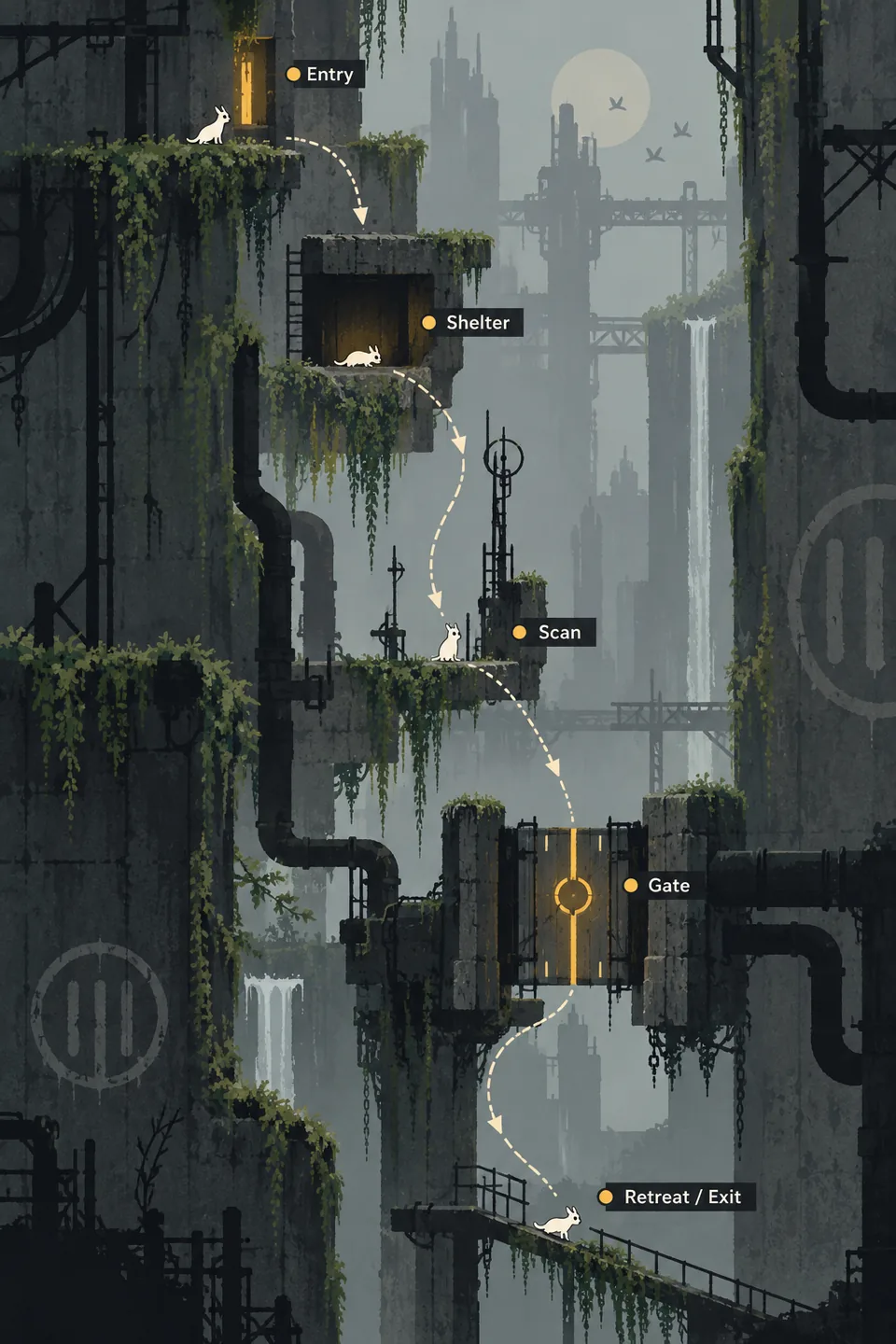
Open the interactive Rain World map and begin with the region you are currently in, not the far destination you hope to reach. Turn on region connections and shelter markers first. Then trace one branch to the gate and one branch back to a safe sleep point. Optional pearls, Echoes, and creature markers are useful only after the basic crossing is legible.
Use a two-pass workflow. First confirm that the connection exists for your slugcat and that the requirement is realistic. Then check the first shelter, food, and route back after the crossing. The existing progression guide covers broad region order; this page focuses on the transition decision.
- Pass 1: current room, gate requirement, nearest shelter, and route back.
- Pass 2: first post-gate shelter, food source, hazards, and optional objective.
- Hide nonessential markers until you have a clear cycle objective.
- Use the region guide for room details and this gate guide for transition decisions.
Campaign and slugcat exceptions
Survivor and Monk are the clearest campaigns for learning gate logic, but they do not make every route universal. Monk can have more forgiving gate behavior after a gate has been used, while Hunter's shorter campaign window makes a long karma recovery loop more expensive. Downpour slugcats can begin in different regions, use different objectives, or encounter connections that are not relevant to the base-game route.
Artificer can make a dangerous approach feel reachable without removing the gate requirement. Spearmaster, Rivulet, Gourmand, Saint, and Watcher each change the value of a transition, so select your campaign before copying a map branch.
| Campaign context | Planning emphasis | Do not assume |
|---|---|---|
| Survivor or Monk first run | Shelters, food, and a readable learning curve. | That the shortest connection is the best next step. |
| Hunter | Cycle budget, recovery cost, and a route with few wasted crossings. | That a slow karma reset is harmless. |
| Artificer | Scavenger pressure, combat space, and gate alternatives. | That explosive movement replaces preparation. |
| Gourmand, Spearmaster, or Rivulet | Campaign objective, movement strengths, and different region timing. | That the Survivor route is optimal. |
| Saint or Watcher | Story-specific access and the correct campaign map layer. | That every vanilla gate and region remains available in the same form. |
Common karma gate mistakes
The most common error is treating a gate symbol as the whole route. A correct number does not tell you whether the next region has food, whether the gate is one-way, or whether your current cycle has enough time to reach a shelter. The second error is using a broad world map without selecting a campaign. This can make a valid route appear missing or make an unavailable branch look guaranteed.
A third error is spending every cycle on the same attempt after a death. Bank a reliable hibernation, use a safer loop, and return with a clear reason. Hide collectible markers until the connection is understood.
- Do not confuse current karma with maximum karma; the gate checks the current state.
- Do not count an already-used gate as a fresh attempt in the same cycle.
- Do not use a region page's route as proof that another campaign has identical access.
- Do not call an editorial diagram an exact room-by-room map.
Rain World karma gates FAQ
Map references
- Karma Gate mechanics and activation notes - Rain World Wiki: Karma Gate
- Community regional gate reference - Steam Community: Karma Gates & Regions Map
- Exact room connections and campaign layers - Rain World Interactive Map
Last updated: October 23, 2026
Open the interactive Rain World map